
Insights

Payers Use AI Technology to Deny Claims. Now Michigan Providers Can Use It to Fight Back
Joyn Health and PromptWrx announced a partnership to help Michigan provider organizations recover revenue lost to denials, underpayments, and increasingly complex payer rules. The collaboration pairs Joyn’s Claims Defender platform with PromptWrx’s Reve AI for Revenue Cycle, which was built by former payer executives who know exactly how provider claims get adjudicated, and denied.
Read insight
Getting Past The Test Drive: Getting RCM AI From Demo To Production
HFMA asked three revenue cycle leaders for the one AI question their peers should be asking. Their answers are the right ones for a health system to ask of itself, but they aren't tough enough to ask of a vendor. Drawing on years of building adjudication AI on the payer side, I lay out seven questions to ask before you sign: paid dollars, current policy, triage, traceability, real oversight, payer fluency and a baseline you own. Because a demo is a test drive on a sunny day.
Read insight
Denials Use the Front Door. Recoupments Use the Back.
Most health systems have gotten good at working denials, but payer recoupments get past those workflows: they show up months or years later as offsets and adjustments on the remit, which a new Becker's whitepaper with SCA Health and Cleveland Clinic leaders calls a hidden margin threat. Having built AI for insurers, the PromptWrx team explains how payers recover money after payment without asking, and why providers often don't notice. The article gives six practical steps, including reading the PLB segment, giving recoupments an owner and citing the policy in effect on the date of service, and closes by showing how Reve reads what comes back from payers so providers can keep the money they've already been paid.
Read insight
The Payers Are Winning. We Know. In A Past Life We Built Their Models.
Twenty-two revenue cycle leaders told Becker's the most dangerous trend in their world, and HCA's CFO put it bluntly two days later: "We're behind the payers." Payers now review 100% of claims with AI and quietly downcode what they don't deny outright, while most providers still read a fraction of what comes back and answer with letters that no policy stands behind. The PromptWrx team built those payer models in a past life, and this post lays out five things provider leaders can do Monday to stop training the other side with their silence.
Read insight
Policy Drift Cuts Both Ways. Most Providers Only See the Downside.
Payers change coverage criteria and coding rules continuously and without notice, and the lag before your organization operates under the new rule quietly generates denials that were never clinical. What almost no one works is the other direction: payers also deny under policies that weren't in effect on the date of service — and that's a recoverable argument, if you can prove what the rule said back then.
Read insight
Payers Aren't Making Mistakes. Would You Rather Be Right, or Get Paid?
Most denials aren't errors to correct — they're the designed output of payer logic doing its job. The only question that moves money is whether your denial strategy is built to get paid, not just to be right.
Read insight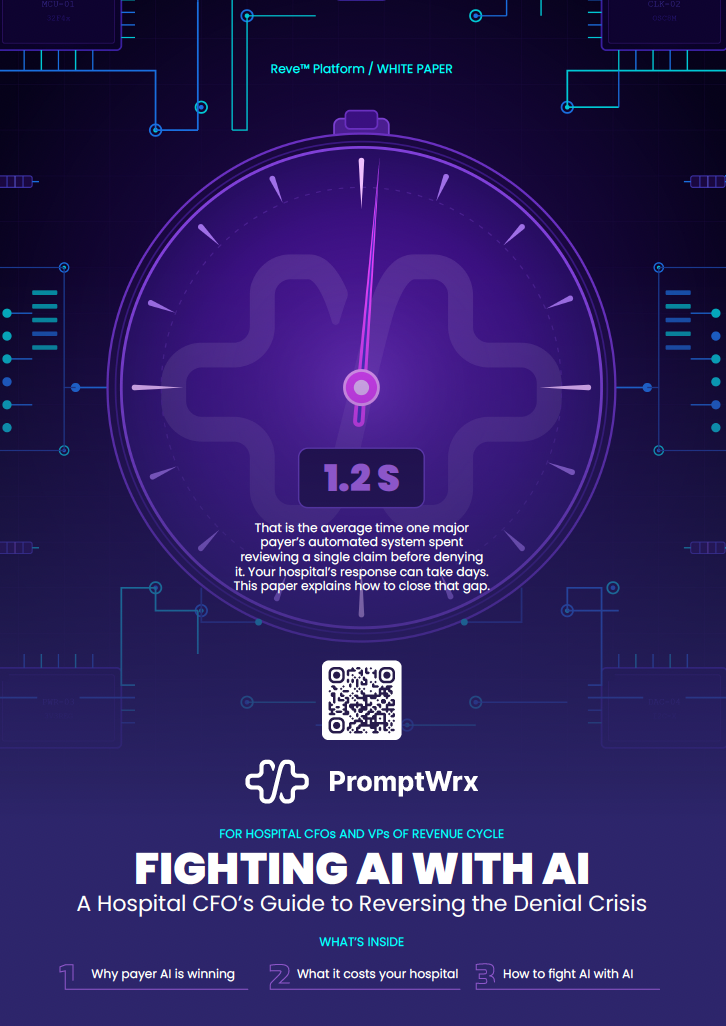
Fighting AI with AI: A Hospital CFOs Guide To Reversing The Denial Crisis
The Payer advantage is now an algorithmic one. Download the white paper to learn how to combat AI driven denials using AI designed to think like a payer.
Read insight